
A Short History of Nearly Everything by Bill Bryson
Introduction
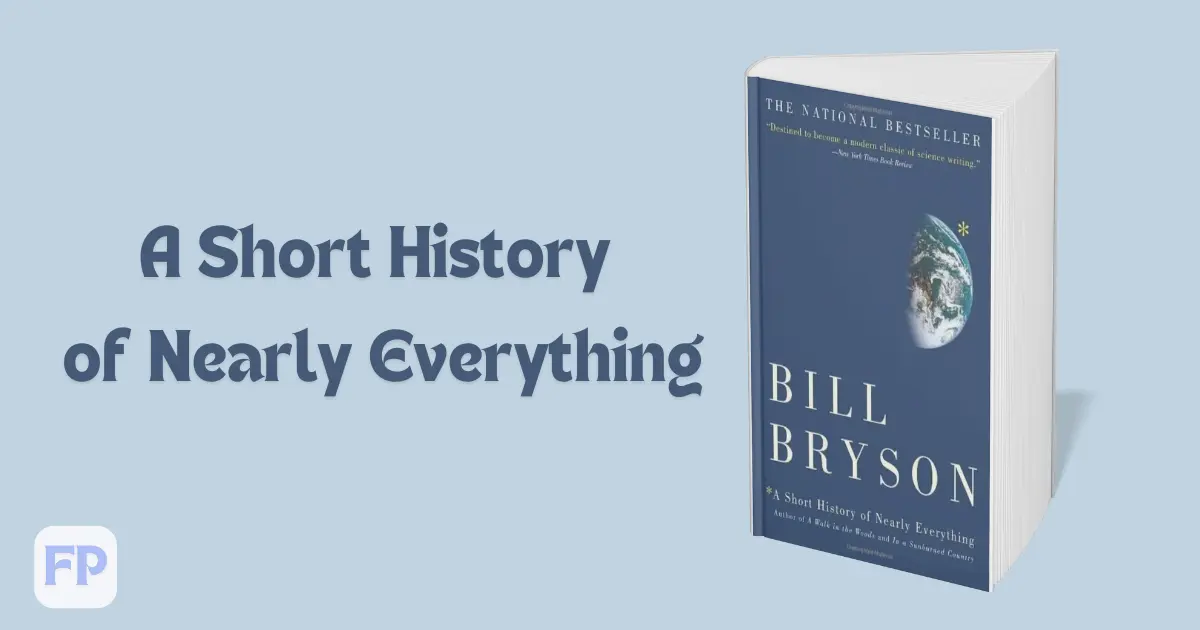
A Short History of Nearly Everything by Bill Bryson is an ambitious and accessible journey through the annals of science and human understanding. Bryson, primarily known for his travel writing, steps into the realm of popular science, aiming to demystify complex scientific concepts for the layperson. The book serves as both a tribute to science and an ode to the scientists whose curiosity has unveiled the wonders of our world.
Bryson embarks on this journey due to his own curiosity about the world and his desire to understand the science that explains it. His approach is characterized by wit, humor, and humility, making difficult subjects like the Big Bang, quantum physics, and evolution engaging and understandable. Through this book, readers are not only educated but are also entertained, reflecting Bryson's unique style of delivering content that is both insightful and enjoyable.
The book is organized into six sections, each exploring different facets of science, from the cosmos and the formation of Earth to the rise of life and humanity. This summary encapsulates these sections, providing a comprehensive yet concise look at the book's key points and themes.
Main Themes
Curiosity and Discovery
At the heart of A Short History of Nearly Everything is the theme of curiosity and discovery. Bryson himself embodies this theme, driven by an insatiable quest to understand how the world works. He explores the history of scientific exploration, emphasizing that science is not only a body of knowledge but also a process of discovery. Bryson celebrates the role of scientists—often quirky and eccentric—in this grand quest for understanding. The narrative underlines how curiosity has propelled humanity forward and how important it is to keep asking questions.
The Vastness and Complexity of the Universe
Another central theme is the vastness and complexity of the universe. Bryson begins with the cosmos, addressing the mysteries of the universe from the Big Bang to the present day. He explores the immense scales at which the universe operates and how humans have managed to comprehend it, from the tiniest subatomic particles to the farthest galaxies. Bryson provides context for humanity's place in this immense expanse, evoking a sense of awe and humility.
Interconnectedness of Life
Bryson delves into the interconnectedness of life, exploring how all forms of life, including humans, are connected to each other and to the planet. He highlights the delicate balance of ecosystems and the intricate web of biological processes. This theme is underscored by Bryson's discussion of evolution and how life has adapted and thrived on Earth through complex, interdependent systems. By examining the rise of life and the development of numerous species, Bryson challenges readers to appreciate the miracle of existence and the interconnected nature of all living things.
Risks and Resilience of Life on Earth
Throughout the narrative, Bryson also addresses the risks and resilience of life on Earth. He examines natural disasters, extinctions, and the fragility of life, as well as the resilience of species that have adapted to survive. The book underscores the importance of protecting our planet's biodiversity and understanding the impacts of human activity on Earth's ecosystems. Bryson invites readers to reflect on their role in preserving the only home we've ever known, emphasizing that the story of life on Earth is one of resilience, adaptation, and an ongoing struggle for survival.
Key Points
The Cosmos and the Big Bang
Bryson sets the stage with a discussion of the origin of the universe. He explains the Big Bang Theory, which posits that the universe began with a massive explosion about 13.8 billion years ago. He walks readers through the complexities of cosmology—from the expansion of the universe to the nature of black holes—infusing scientific theories with historical anecdotes about the scientists who developed them.
The book highlights how early scientists and astronomers, such as Edwin Hubble, revolutionized our understanding of the cosmos by demonstrating that galaxies are moving away from each other, effectively expanding the universe. Bryson humanizes these figures, exploring their personalities and quirks, which makes the vast fields of astronomy and physics more relatable and understandable.
Atoms and Subatomic Particles
From the broad sweep of the cosmos, Bryson shifts his focus to the infinitesimally small world of atoms and subatomic particles. He explains the fundamental components of matter, how atoms are built, and how they interact to form the world around us. Bryson explores the pioneering work of scientists like Ernest Rutherford and Niels Bohr, who helped unravel the mysteries of atomic structure.
Using plain language and metaphors, Bryson elucidates complex concepts like quantum physics and the behaviors of particles at the atomic level. The book conveys the mysteries and uncertainties that still surround quantum mechanics, reminding readers that much of what we think we know is based on probability rather than certainty.
Geology and the Formation of Earth
Bryson's exploration of geology and the formation of Earth offers insights into the powerful forces that have shaped our planet. He covers the geological time scale, emphasizing the brevity of human existence in comparison to Earth's history. Readers are introduced to concepts like plate tectonics, volcanic activity, and the processes of erosion and sedimentation that continually reshape the planet's surface.
The book highlights the work of early geologists, such as James Hutton and Charles Lyell, who laid the groundwork for modern geology. Bryson also discusses the discovery of the Earth's age, the significance of fossils, and how Earth's unique conditions have allowed life to flourish.
The Evolution of Life
Bryson provides an engaging account of the evolution of life, detailing how life began and evolved to its current diversity. He examines the origins of life, from single-celled organisms to the complex web of species that inhabit Earth today. The book addresses key evolutionary milestones, such as the Cambrian explosion, the development of sexual reproduction, and the rise of mammals.
Bryson delves into the innovative theories of Charles Darwin and Alfred Russel Wallace, emphasizing the significance of natural selection and adaptation in shaping the variety of life. He presents evolution not as a ladder leading to humans but as a sprawling tree with countless branches, each representing different evolutionary pathways.
Human Biology and Health
In exploring human biology and health, Bryson reveals the marvels and mysteries of the human body. He discusses the biological processes that sustain life, including metabolism, immune responses, and the mechanics of the brain. The book covers significant advancements in medicine and the development of life-saving technologies.
Bryson addresses the complex interplay between genes and the environment, highlighting discoveries in genetics and the Human Genome Project. He discusses the imperfections of the human body, illustrating how evolution's adaptations are not always optimal solutions. Throughout, Bryson adds a personal touch, sharing anecdotes that resonate with readers and underscore the importance of scientific research in improving human health.
Paleontology and Extinctions
A significant portion of Bryson's narrative is devoted to paleontology and extinctions, exploring the history of life through the fossil record. He explains how fossils provide clues to past life forms and how catastrophic events have led to mass extinctions, reshaping the evolutionary pathway.
Bryson recounts the discovery of dinosaurs and the widespread fascination they evoke. He highlights the extinction events that punctuated Earth's history, including the most famous of all, the Cretaceous-Paleogene extinction that wiped out the dinosaurs. By examining these events, Bryson emphasizes the fragility and unpredictability of life on Earth.
Climate and Environmental Change
Bryson addresses climate and environmental change, examining both natural fluctuations and the impact of human activity. He discusses historical climate shifts, the science of climatology, and current concerns about global warming. Bryson warns of the dangers facing ecosystems and species as a result of human-induced changes, urging readers to recognize the importance of sustainable practices.
Drawing from scientific consensus and research, Bryson underscores the urgency of addressing climate change to prevent irreversible damage to Earth's biosphere. He explores the interplay between climate and human civilization throughout history, emphasizing how understanding past climates can inform our response to contemporary challenges.
The Nature of Scientific Inquiry
Bryson concludes with a reflection on the nature of scientific inquiry. He highlights the collaborative nature of science, showing how discoveries often build on the foundations laid by others. Bryson celebrates the tenacity of scientists who pursued truth despite skepticism and setbacks, underscoring that science is a collective endeavor that thrives on open-mindedness and critical thinking.
The book emphasizes the perpetual journey of science, where answers lead to new questions and the pursuit of knowledge is never-ending. Bryson inspires readers to adopt a mindset of curiosity and wonder, recognizing that there is always more to learn about the world.
Conclusion
Bill Bryson's A Short History of Nearly Everything is a captivating exploration of science that bridges the gap between complex scientific concepts and the everyday reader. With his signature humor and engaging style, Bryson sheds light on the mysteries of the universe, the evolution of life, and the marvels of human existence. The book is a testament to the power of curiosity and the relentless pursuit of knowledge that defines the human spirit.
Through his narrative, Bryson invites readers to appreciate the wonders of the natural world and the remarkable achievements of science. By making science accessible and enjoyable, Bryson encourages a deeper understanding of our place in the universe and the interconnectedness of all life. Ultimately, A Short History of Nearly Everything is not just a chronicle of science; it is a celebration of human ingenuity and the endless quest to know more.