
Determined: A Science of Life without Free Will - Book Summary
Introduction
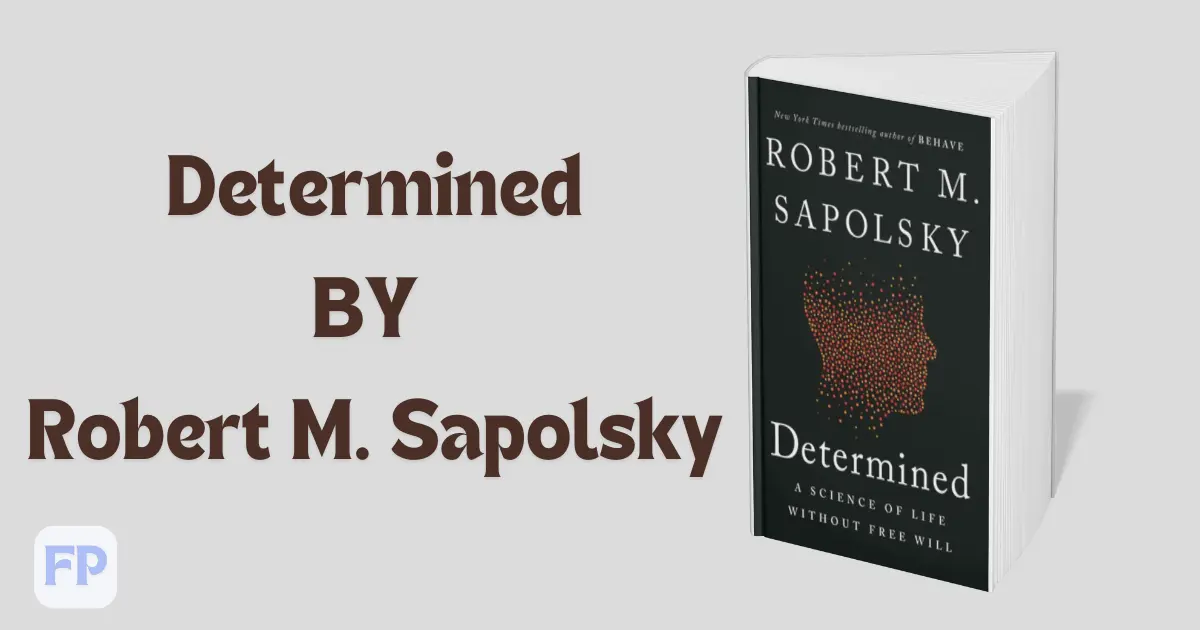
Robert M. Sapolsky, a renowned neuroscientist and author, delves into the controversial subject of free will in his intriguing work, Determined: A Science of Life without Free Will. Sapolsky aims to dissect and challenge the long-held belief of human free will, presenting a robust scientific analysis of human behavior to argue that free will is an illusion. This book combines insights from neuroscience, psychology, and philosophy, appealing to readers interested in understanding the mechanics behind human decision-making and the implications of a deterministic view of behavior.
Main Themes
The Illusion of Free Will
Sapolsky emphasizes that what we typically perceive as free will or the conscious choice is arguably an illusion. By presenting evidence from various scientific disciplines, he posits that our decisions and actions are predetermined by a complex interplay of genes, hormones, and neural circuits. He suggests that human behavior results from biological factors we have no control over, painting a picture of a predetermined life trajectory for each individual.
Biological Predeterminism
One of the central themes is biological predeterminism. Sapolsky illustrates how our behaviors are nearly always influenced by our biology. He explores the depths of genetic and neurobiological substrates responsible for guiding behavior, arguing that human actions are often the result of millenia-old evolutionary processes. In particular, the configurations of our brains and developmental experiences significantly shape our responses.
Intersection of Neuroscience and Philosophy
Sapolsky explores the nexus between neuroscience and philosophy, examining the existential implications of a world without free will. He questions how this perspective alters our understanding of human responsibility, ethics, and the foundations of societal systems like justice. By discussing philosophical stances such as determinism and compatibilism, he weaves a narrative that challenges the reader to reconsider fundamental human beliefs.
Implications for Society and Ethics
The book makes a powerful case for revisiting our ethical foundations. Sapolsky argues that the myth of free will should be cast aside for more scientifically-backed understandings of moral responsibility. He suggests that accepting determinism can transform how society addresses crime and punishment, mental health, and social justice, advocating for more compassionate and context-driven approaches to societal issues.
Key Points
Neuroscience and Decision Making
Sapolsky delves into the complexities of how our brains make decisions. Through a detailed analysis that encompasses neural pathways and neurotransmitter activities, he draws links between brain functions and behavior, demonstrating how seemingly autonomous decisions emerge from a deterministic biological foundation.
The Role of Consciousness
In evaluating consciousness's role in decision-making, Sapolsky questions the extent to which our conscious minds play a role in directing our actions. He argues that much of what we consider conscious choice is post-hoc interpretation by the conscious mind of decisions already made by subconscious processes. This challenges readers to reconsider the authenticity of self and where true agency lies.
Legal and Moral Structures
By extending the implications of biological determinism to legal and moral systems, Sapolsky raises questions about holding individuals morally and legally accountable for actions that are biologically hardwired. He discusses potential reforms in the criminal justice system, such as focusing more on rehabilitation than punishment, fostering a society more attuned to the nuances of human behavior and its deterministic roots.
Evolutionary Biology
Sapolsky intricately links evolutionary biology with behavior, illustrating that many impulses and decisions stem from ancient survival mechanisms. He connects modern behaviors to primitive instincts, suggesting that understanding these links could enhance our approach to changing or managing problematic behaviors.
Culture and Environment
While emphasizing biological determinism, Sapolsky also considers culture and environment as crucial aspects influencing behavior. These factors interact with biology, creating a dynamic interplay that shapes the human experience. Cultural norms, socio-economic status, and historical contexts are explored as modifiers of behavior, indicating that while biology lays the groundwork, culture and environment paint the details.
Conclusion
In Determined: A Science of Life without Free Will, Robert M. Sapolsky provides a thorough and thought-provoking investigation into the realm of human decision-making. By deconstructing the notion of free will through a scientific lens, Sapolsky encourages a radical reassessment of how we perceive human behavior. His work advocates for a transformation in societal structures to accommodate a deterministic understanding of human actions, potentially leading to more humane and effective systems. This book offers penetrating insights for anyone willing to question and explore the foundational aspects of human nature and ethics. Through a compassionate lens, Sapolsky invites readers to consider how a future shaped by deterministic understanding could enhance empathy, justice, and progress.