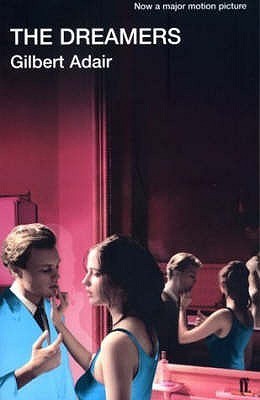
Gilbert Adair's novel is set in Paris in the spring of 1968. The city is beginning to emerge from hibernation and an obscure spirit of social and political renewal is in the air. Yet Théo, his twin sister Isabelle and Matthew, an American student they have befriended, think only of immersing themselves in another, addictive form of hibernation: moviegoing at the Cinémathèque Française. Night after night, they take their place beside their fellow cinephiles in the very front row of the stalls and feast insatiably off the images that flicker across the vast white screen.
Denied their nightly 'fix' when the French government suddenly orders the Cinémathèque's closure, Théo, Isabelle and Matthew gradually withdraw into a hermetically sealed world of their own creation, an airless universe of obsessive private games, ordeals, humiliations and sexual jousting which finds them shedding their clothes and their inhibitions with equal abandon. A vertiginous free fall interrupted only, and tragically, when the real world outside their shuttered apartment succeeds at last in encroaching on their delirium.
The study of a triangular relationship whose perverse eroticism contrives nevertheless to conserve its own bruised purity, brilliant in its narrative invention and startling in ints imagery, The Dreamers (now a film by Bernardo Bertolucci) belongs to the romantic French tradition of Les Enfants Terribles and Le Grand Meaulnes and resembles no other work in recent British fiction.
Gilbert Adair was a Scottish novelist, poet, film critic and journalist. Born in Edinburgh, he lived in Paris from 1968 through 1980. He is most famous for such novels as Love and Death on Long Island (1997) and The Dreamers (2003), both of which were made into films, although he is also noted as the translator of Georges Perec's postmodern novel A Void, in which the letter e is not used. Adair won the 1995 Scott Moncrieff Translation Prize for this work.
In 1998 and 1999 Adair was the chief fil…
Read more